

A finished leather diary or document folder looks simple sitting on a desk, but getting there involves a long chain of decisions — most of which happen long before anyone picks up a needle and thread. This guide walks through how a leather corporate gift is actually made, from the raw hide to the final quality check, and why each stage matters more than it might seem.
It Starts With the Hide — Selection and Tanning
Every leather corporate gift starts with a decision that happens long before any cutting or stitching begins: assessing the raw hide itself. The quality of a finished product depends heavily on the condition of that hide — scars, insect bites, and improper handling can all affect its final appearance and performance, which is why hides are inspected and sorted before processing even starts. Higher-quality hides, with fewer surface imperfections, are typically reserved for premium leather corporate gifts, while lower-grade hides are used for products with more heavily corrected finishes.
Tanning is the step that fundamentally transforms a raw hide into stable, usable leather. This process gives leather its texture, durability, and resistance to decay, using methods ranging from traditional vegetable tanning to modern chrome tanning depending on the desired result. After tanning, hides are split and shaved to a consistent thickness appropriate for the intended product — a padded diary cover and a slim document folder may call for genuinely different thicknesses of the same base material.
This early stage rarely gets talked about, but it sets the ceiling for everything that follows. No amount of skilled stitching or branding later in the process can fully compensate for a poor-quality hide chosen at the very start.
Dyeing, Finishing, and the Look of the Final Material
Dyeing and finishing give leather its final color and surface character, and this is where a lot of a leather corporate gift’s visual identity gets decided — well before it ever reaches a cutting table. Techniques like aniline dyeing produce a more natural, vibrant look that preserves more of the hide’s original grain, while heavier pigmented finishes mask more of the natural surface in exchange for a more uniform, consistent appearance across a large batch.
Neither approach is inherently better — the right choice depends on what a particular leather corporate gift is meant to look and feel like. A natural-grain finish suits a product meant to show the character of real leather, while a more uniform finish suits a product where consistency across hundreds or thousands of units matters more than natural variation.
This stage also shapes how the leather will behave later during branding. A finish that’s too heavy can make foil stamping or debossing look flat, while a well-chosen finish lets these techniques catch light and shadow properly, adding real depth to the final design.
Cutting, Skiving, and Stitching — Where Durability Is Built
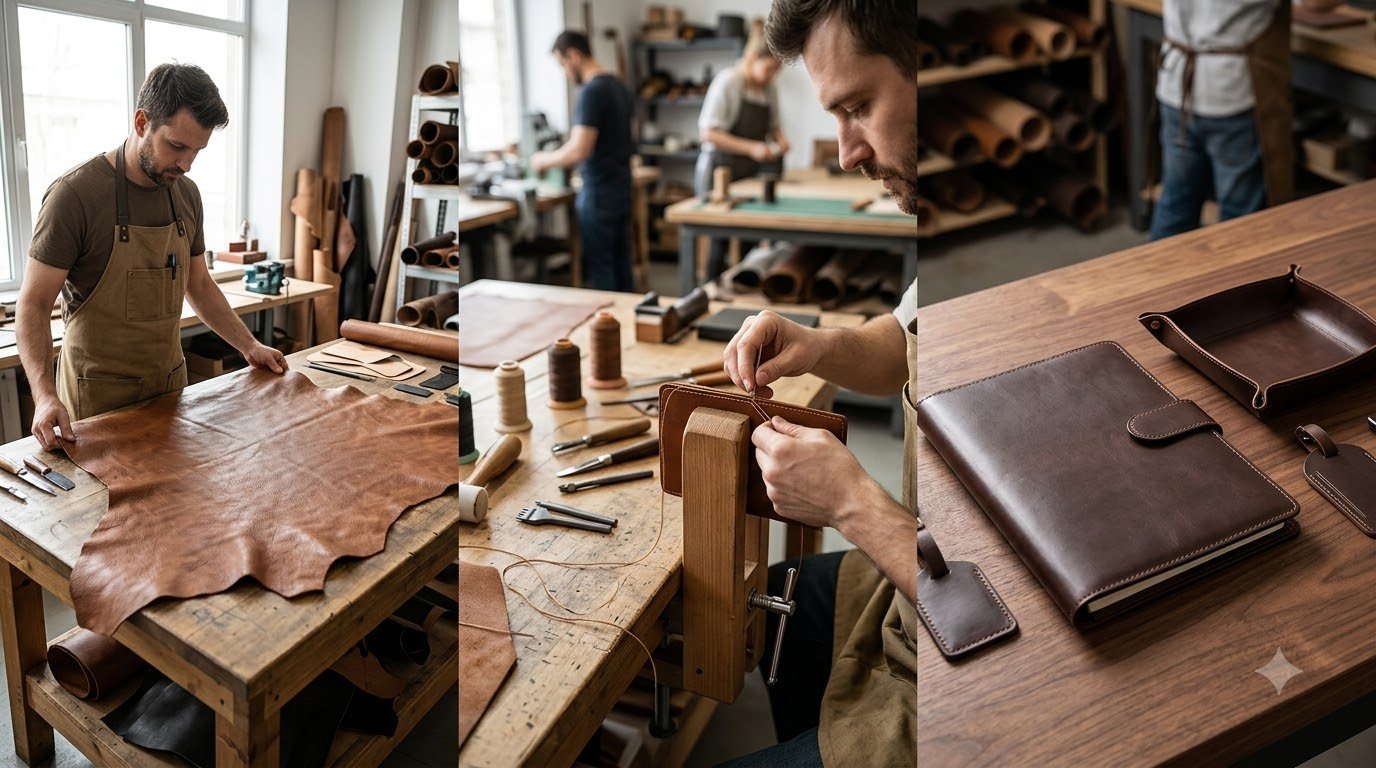
Once finished leather reaches a manufacturer, it’s cut into pattern pieces — and how carefully this is done directly affects the final product’s quality. In quality-focused production, cutting is done to use the best parts of the hide and avoid areas with surface defects, rather than optimizing purely for minimum waste. Skiving, which thins the leather at the edges, prevents unwanted bulk at seams and folds — done well, it creates a refined, seamless feel; done poorly, it can actually weaken the leather at points of stress.
Stitching is where a great deal of a leather corporate gift‘s long-term durability is actually decided. Thread type, stitch density, and technique all affect how well a seam holds up over months or years of daily handling — waxed thread is standard in quality leather goods because it resists moisture and abrasion better than untreated thread. Stitch density matters more than most buyers realize: too few stitches per inch and a seam is weak, too many and the leather gets perforated to the point of tearing along the stitch line.
These construction details rarely get photographed or highlighted in a product listing, but they’re often the difference between a leather corporate gift that holds up for years and one that starts fraying within months of regular use.
Edge Finishing, Branding, and Final Quality Checks
Edge finishing is one of the clearest visible signs of quality in a finished leather corporate gift. Raw edges fray over time, burnished edges — repeatedly rubbed and polished to compress the fibers — take real time and skill but hold up far longer, and painted edges look clean initially but can chip with continued use. This is a detail most people notice without necessarily knowing why it matters, which makes it one of the more telling quality checks on any finished piece.
Branding is applied after the base leather piece is finished, adding a design layer without altering the leather’s underlying construction. Foil stamping, embossing, and debossing each interact differently with the material beneath them, which is part of why the earlier dyeing and finishing choices matter so much to how the final branding actually looks.
Quality checks happen at multiple points along the way, not just at the very end. In-line checks during assembly — monitoring stitch density, edge finish, and alignment — catch inconsistencies before they reach the final product, and a final audit checks dimensional accuracy and overall finish consistency before anything is considered ready for packaging and shipment.
Bringing It All Together
A finished leather corporate gift represents a long chain of decisions — hide selection, tanning, dyeing, cutting, stitching, edge finishing, and branding — each one shaping what the final product looks and feels like years down the line. Understanding this process doesn’t just satisfy curiosity; it helps buyers ask better questions and recognize genuine quality when comparing options. A manufacturer that can speak clearly to each of these stages is usually one that takes real pride in getting them right.
If you’re curious about how your next leather corporate gift would be made, or want to talk through material and finishing options, get in touch to walk you through the process.