

Picking a custom diary feels simple until you’re staring at a dozen size options, cover types, and paper weights with no idea where to start. Whether you’re ordering one for yourself or putting together a batch for your team, the size and material you choose will either make it something you reach for every morning or something that ends up forgotten in a drawer. This guide breaks it all down in plain language so you can make the right call the first time.
TABLE OF CONTENT
- Why Getting These Two Things Right Actually Matters
- What Are You Actually Using It For?
- The Size Guide — Plain and Simple
- Cover Materials — What’s the Actual Difference?
- Paper Quality — The Part Most People Ignore
- Making It Personal — Customisation That Actually Adds Value
- Quick Reference — Match Your Needs to the Right Combo
- Conclusion
- Frequently Asked Questions
Why Getting These Two Things Right Actually Matters
Most people spend more time picking a phone case than they do choosing a diary. And then wonder why they stop using it after two weeks.
The truth? A custom diary that doesn’t fit your bag, your handwriting style, or your daily habits will collect dust — no matter how pretty it looks on a shelf. But when the size and material are exactly right, writing in it becomes second nature. You stop thinking about the diary and start thinking in it.
This guide cuts through the confusion and helps you figure out exactly what you need — before you order.
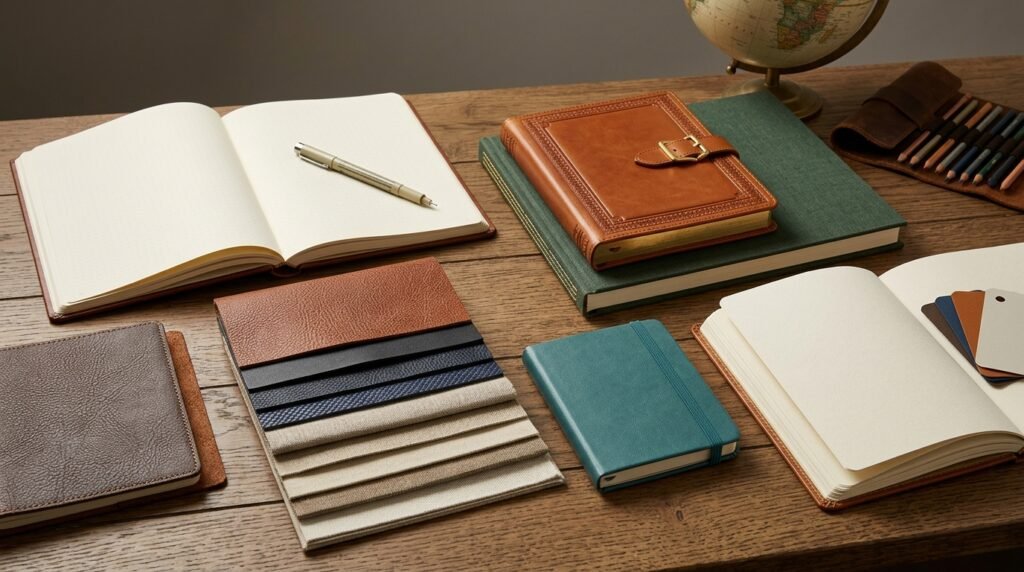
What Are You Actually Using It For?
Before we talk sizes and covers, ask yourself one honest question: How will I use this diary every single day?
The Daily Carry Crowd
If your diary lives in your bag, jacket pocket, or gets tossed on a café table daily, you need something compact and sturdy. Beat-up corners and ink smudges aren’t charming — they’re just wear and tear you didn’t plan for.
The Desk Dweller
If your diary sits on your work desk and rarely leaves the office, you have more room to play. Larger formats, softer covers, and premium paper all become realistic options when your diary isn’t being knocked around.
The Creative Journaler
Artists, bullet journalers, and sketch-note fans need lay-flat binding, wider pages, and paper that can handle ink bleed, markers, or even light watercolour. Functionality here beats aesthetics every time.
The Size Guide — Plain and Simple
Custom diary sizes follow global standards, but knowing what each actually means in real life saves a lot of regret.
A6 — The Pocket Companion
Roughly the size of your palm. Fits in a jacket pocket or small crossbody bag. Great for quick notes, daily to-do lists, or keeping a gratitude journal. Not ideal for detailed planning or creative work — the pages fill up fast and there’s not much room to breathe.
Best for: Minimalists, travellers, and people who want to carry a diary without feeling like they’re lugging a textbook.
A5 — The Sweet Spot
Half an A4 sheet. This is the most popular size for personalised diaries, and for good reason — it’s spacious enough for structured planning but compact enough to carry comfortably. Most weekly and monthly planners use this format.
Best for: Professionals, students, and anyone who wants a balance between portability and space.
B5 — The Underrated Middle Ground
Slightly wider than A5 but not quite as large as A4. Writers and journalists who find A5 a touch cramped but don’t want the bulk of A4 often swear by this size. Still relatively rare in off-the-shelf options, which makes it a standout choice for a custom notebook diary.
Best for: Writers, content creators, and detail-oriented planner
A4 — The Full-Page Format
Standard document size. Gives you maximum writing space ideal for meeting notes, project planning, or creative layouts. The trade-off is portability; these are desk diaries, not travel companions.
Best for: Executives, architects, and anyone whose diary functions more like a working document.
Cover Materials — What's the Actual Difference?
The cover is what you touch every day. It affects durability, look, feel, and how the diary ages over time. Here’s what you need to know.
Genuine Leather — Classic, but Earned
Nothing ages quite like real leather. It develops a patina over time, softens with use, and looks significantly better after a year than it did on day one. It’s also the most premium option in terms of cost.
If you’re ordering premium custom notebooks as corporate gifts or executive diaries, genuine leather is hard to beat for the impression it makes.
Watch out for: Higher price point and the need for occasional conditioning to prevent cracking.
PU (Faux) Leather — The Practical Choice
PU leather mimics the look and feel of genuine leather at a fraction of the cost. It’s consistent in texture, easy to clean, and holds embossing and debossing very well — which matters a lot if you’re customising with a logo, name, or pattern.
Best for: Corporate gifting, bulk orders, and anyone who wants a leather-look diary without the maintenance.
Hard Cover (Cardboard/Board) — Clean and Structured
Rigid covers with fabric, paper, or printed wraps on top. These are clean, minimal, and highly customisable in terms of colour and finish. Not as tactile as leather options, but structurally reliable and often more affordable.
Best for: School diaries, branded merchandise, and designs where visual impact matters more than texture.
Soft Cover — Flexible and Lightweight
These bend and flex without cracking. Lighter than hardcovers and often used in travel journals and pocket diaries. The trade-off is that they offer less protection to the pages inside.
Best for: Travellers, artists who want a diary that can be folded back on itself, and everyday journalists.
Paper Quality — The Part Most People Ignore
You can have the most beautiful cover in the world and still end up frustrated if the paper inside isn’t right for how you write.
GSM — What It Means
GSM (grams per square metre) is the weight of the paper. Higher GSM = thicker paper.
- 60–70 GSM — Light, standard, works fine for ballpoint pens
- 80–90 GSM — The sweet spot for most writers; handles gel pens without major bleed-through
- 100+ GSM — Premium feel; ideal for fountain pens, markers, or anyone who presses hard
Ruling Options
Lined, dotted, blank, or grid — each serves a different purpose. Dotted pages have become especially popular for bullet journaling and structured planning because they’re versatile without being visually rigid.
Making It Personal — Customisation That Actually Adds Value
A custom diary should feel like it was made for you — or in the case of gifting, for a specific person or brand. A few customisation elements worth thinking about:
- Embossing or debossing a name, monogram, or logo on the cover
- Foil stamping for a high-end finish
- Custom elastic bands and ribbon bookmarks in brand colours
- Inner page printing — dates, prompts, quotes, or a branded layout
These aren’t just decorative. They make the diary more functional and far more likely to actually be used.
Quick Reference — Match Your Needs to the Right Combo
Use Case | Recommended Size | Recommended Cover | Paper Weight |
Daily professional planning | A5 | PU Leather / Hard Cover | 80–90 GSM |
Corporate gifting | A5 / A6 | Genuine Leather / PU Leather | 80 GSM |
Creative journaling | B5 / A5 | Soft Cover / Hard Cover | 100+ GSM |
Travel diary | A6 | Soft Cover / PU Leather | 70–80 GSM |
Desk planner | A4 | Hard Cover | 80 GSM |
Conclusion
Choosing a custom diary isn’t complicated once you understand what actually goes into it. Size determines how you carry it. Material determines how it lasts. Paper determines how it feels to use. And customisation is what turns a notebook into something you genuinely want to pick up every day.
Whether you’re creating one for yourself or ordering in bulk for a team, the right decisions made upfront save a lot of disappointment later. If you’re ready to put this into practice, explore the full range of handcrafted custom stationery options and find the combination that works for you.