

Every company wants new hires to feel welcomed and every employee to feel remembered — but a single email or a one-time gift card rarely does that job well. A branded desk essentials kit solves this differently: it puts your brand into daily use, not just a passing moment. This guide walks through why these kits work, what to put in one, how to brand them well, and how to match a kit to the occasion.
TABLE OF CONTENT
Why Desk Essentials Kits Work as a Corporate Gift
New hires decide how long they’ll stay with a company remarkably early — often within their first six months, sometimes within the first few weeks. Companies that get this window right see retention rates climb sharply, with structured onboarding linked to significantly higher retention and stronger early productivity. That first impression, in other words, is doing more work than most HR calendars give it credit for.
A well-put-together desk kit fits directly into that window. Handing a new employee a folder, notebook, and pen on day one signals preparation and care before a single meeting happens. It’s a small gesture, but it lands at the exact moment employees are forming their opinion of the company.
What makes a desk kit different from a coffee mug or a t-shirt is repetition. A notebook gets opened daily; a pen gets picked up without thinking. Each use is a quiet, low-effort touchpoint that keeps reinforcing the brand — something a one-time gift simply can’t replicate over months of use.
What to Include in a Branded Desk Kit
Most effective kits are built around a small set of genuinely useful items rather than a pile of novelty extras. A document folder for meetings and onboarding paperwork, paired with a notebook for daily notes, forms the practical backbone. These are items people reach for constantly, not ones that sit in a drawer.
A pen rounds out the essentials — and the choice of pen matters more than it seems. A well-chosen pen communicates quality in a way that’s easy to underestimate, since it’s often the item an employee holds the longest each day. Beyond these three, a card holder or small desk organizer can complete the set without overcomplicating it.
The goal isn’t to maximize the number of items in the box. It’s to choose pieces that will genuinely get used at a desk, so the branding keeps showing up in ordinary moments rather than being packed away after the first week.
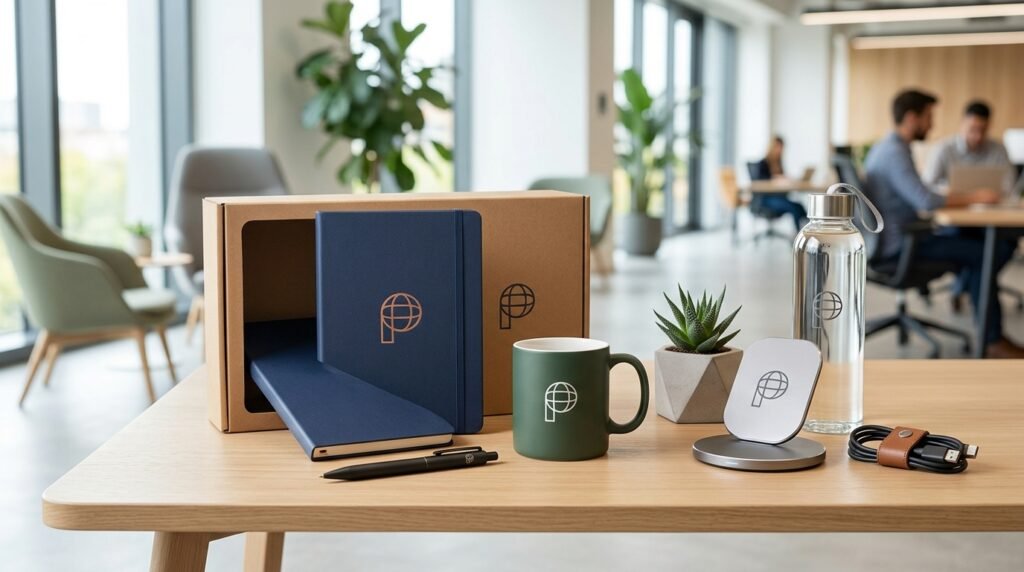
Choosing the Right Branding Technique and Materials
How a logo is applied matters as much as what it’s applied to. Foil blocking and blind embossing both give a refined, understated finish that suits leather and vegan leather surfaces well, while screen printing works better for bold, colourful branding on flatter materials. The right technique depends on the material and the tone the brand wants to strike.
Consistency across the kit matters just as much as the technique itself. A folder, notebook, and pen branded with the same method and colour palette read as one considered set rather than three unrelated items bundled together. Mixing techniques haphazardly can undercut the premium feel a kit is meant to create.
Material choice is increasingly part of this conversation too. Many companies are steering toward eco-conscious materials like vegan leather for kits, since sustainability has become a real factor in how procurement teams choose vendors — not just an afterthought.
Matching the Kit to Occasion, Recipient, and Presentation
Not every kit needs to be identical. Onboarding kits, milestone recognition gifts, and client-facing kits each call for a slightly different mix — a new hire’s welcome kit might prioritise practicality, while an executive gift or long-service award can lean into premium materials. Many companies tier their kits this way, keeping a broader, cost-effective set for general teams and a higher-end version for leadership or top clients.
Budget and quantity shape these decisions early on. Bulk orders for desk kits typically require a minimum order quantity, and per-person budgets vary widely depending on who the kit is for and what occasion it marks. Deciding this upfront avoids scrambling to adjust later once a design is already finalised.
The presentation is the last piece, and it’s easy to overlook. A kit that arrives in coordinated, well-branded packaging feels considered in a way that loose items in a plain box never will. That unboxing moment is part of the gift itself, not just the delivery mechanism for what’s inside.
Bringing It All Together
A branded desk essentials kit works because it turns a single gesture into months of quiet, repeated brand exposure. Getting it right means choosing genuinely useful items, applying a consistent branding technique and material across all of them, and matching the kit to who it’s for and when it’s given. Done well, it’s one of the simplest ways to make a lasting first impression — and to keep making it, one desk at a time.
If you’re ready to put together a kit for your team, check the corporate gifting collections and go through materials, branding techniques, and quantities that fit your budget.